Showing posts with label larimar jewelry. Show all posts

March 30, 2016

Frequently Asked Questions (FAQ)

Hi everybody, just a quick note to tell you that we have decided to include in one of thelarimarshop.com sections a FAQ section to make it easier for our customers to have a reply to their questions at hand!
Nevertheless, we will always be happy to answer any special question that does not appear in this FAQ list.

1. Have your Larimar stones been treated in any way?
Our Larimar stones are pure, genuine, carefully selected at the mines in Bahoruco, southwest of the Dominican Republic, the only place on earth so far, where this unique, awesome stone is found and mined. In the Dominican Republic exists no dyeing stone practice.
2. What is a Larimar specimen stone?
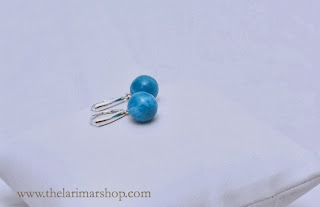
Larimar specimen stone is a stone where the Larimar has developed in different blue and blue green shades, mixed with other materials or inclusions such as hematite or red dendrites (like these earrings), white calcite, natrolite, fossilized wood, copper, etc. creating gorgeous, fabulous, nature designs. Every Larimar specimen stone is unique!
3. Where are you located?
We are located in Santo Domingo, main city of the Dominican Republic; The Dominican Republic shares the eastern side of the Hispaniola Island; Haiti is on the western side!
4. How is your jewelry made?
Our jewelry is made with top quality Larimar stone brought directly from the mines, to our workshop, where young, native artisans cut, shape, polish and mount this semi-precious gem in 925 silver or 14K gold bezel cups.
5. Why should I trust you?
We have been in the Larimar business for many years and we guarantee our jewelry! Our main goal has been and is to make our customers happy with each purchase. To treat each Larimar lover with top quality customer service and at the end gain a new friend.

6. Do I have to pay customs fee?
Customs regulations are different in every country. We recommend you to check with your customs official office. We are willing to assist you with any shipping instructions for customs purposes. We are not responsible for any customs fee or tax in any country.
7. Do you offer express shipping?
Yes, we offer express shipping with guaranteed delivery of 1 – 2 working days inside US and 1 – 4 working days outside US.
8. How do I receive my order?
All orders are beautifully gift wrapped, packed in a small white box, decorated with an aqua blue lace or a raffia lace, to create an exciting moment when you or that person you have gifted with your order receive your package! In the box we include card with a brief history of the Larimar stone and care tips! The Larimar jewel is placed in a white organza pull pouch.
9. Do you make more than one piece of each design featured in your store? 
Most of the Larimar jewelry we are offering are one of a kind, unique in its design, in its blue shade and pattern; if you see a piece that catches your eyes, don’t let it go! When we have more than one unit in stock of the Larimar jewelry displayed, we indicate quantity available, as well as the variety of blue shades and patterns.
10. How does your reversible Larimar and Amber reversible ring work?
This ring is our best seller, loved by all; the 925 silver bezel cup has on one side Larimar and on the other side Amber with two silver shanks to help turn the bezel cup to one of the two stones you want to wear.
11. How do I take care of my Larimar silver jewelry?
It is recommendable to clean your Larimar jewel after wearing it or from time to time, to avoid accumulation of body oil and dirt. Use a jewelry cleaning or polishing cloth to clean the stone and silver.

You can also wash your Larimar piece with clean fresh water and a few drops of mild soap, using a soft brush to clean dirt from the silver setting, rinse and dry with a soft cloth. The Larimar stone might turn more blue due to the water absorption of the stone.
Avoid long sun exposure, salt water and chemicals. When using household and any sort of chemicals, don’t wear your Larimar jewelry to stay away from any possible damage on the stone and/or silver setting. Treasure your Larimar jewelry for this is an awesome, unique stone and there is no reliable source in the Dominican Republic that can secure that we will still find/have Larimar stone for many years to come!!


February 29, 2016

“PECAO FRITO” in the Dominican Republic is a must!

When visiting the Dominican Republic, a piece of paradise in the Caribbean, eating fresh fried fish at the beach is a must, it’s part of our folclor; you will get in contact with our way of enjoying life in a healthy way!!!!!

From the Tainos we have inherited our love for fish, we have good fishermen, specially for fried fish or “pecao frito” (pescado frito) as pronounced by most Dominicans. Although we are an island, fish is much more expensive than meat. Dominican household does not often cook fish as they do with chicken, the number one meat; depending of the region, fish is prepared in different ways. However there is a way fish is prepared we all love and that is fried fish at the beach!!

Practically on all the coast of the Dominican Republic, along the beach and seaside towns,  you will find fresh fish, that is, the catch of the day! There are the typical small places, made of four strong wooden posts and a zinc or palm tree roof, along the beach with a few chairs and a small table! Originally all these chairs were made of “Guano”, but during the past few years, plastic chairs and tables are substituting these chairs.

Close to the beach you will normally find rows of food stands, with a large metal “basin” , locally made, with coal used as fuel, and a large frying pan, where different kind of whole fishes are fried after being rubbed with salt, oregano, coated in flour and then deep fried until crispy! 

Most of the time, the frying oil is reused, which many natives believe gives the fish a special tasty touch!
 
When you are at all these stands you get the feeling of a  Fried Fish Fair, here you are being offered delicious whole fried fish in different sizes/weight, by some guys whose job is to bring customers to the stand they work for! The price of the whole fish is between US$ 8.00 and US$ 10.00, but it will be determined by its size/weight and type! The most popular fishes are the Loro (Parrotfish) and the Chillo (Red Snapper). 


You can buy already fried fish or you can ask for the type of fish you want them to fry for you from the fresh variety they have available! The fish will be always served with lemon slices; to eat with the fish you have a variety of fried food such as plantain(tostones), sweet potato (batata), cassava rolls (bollo de yuca) and Johnny cake  (Yaniqueque), introduced by Afro-descendants coming from other Caribbean islands!

You can also go to a restaurant in town or close to the beach, for a more refined ambience, but you will miss the typical Dominican atmosphere! A beer, normally Presidente, is ordered, as well as, soft drinks for the children and at the rythm of a Bachata or a Merengue, which are the loudly played, you will eat your fried fish! Dominicans will prefer to eat their fish with the fingers; knives and forks (plastic ones) will be ignored, to fully enjoy every bit of their fish!

Dominican Republic has it all, awesome tropical sceneries, beautiful beaches,  mountains, rivers, our unique Larimar stone and friendly people who enjoy life in a simple way!!

March 24, 2015

We finally made it with 14K Gold

Introducing our first Larimar and 14K gold collection!

There is no standard quality guide for our Larimar stone in the Dominican Republic, so far the only place on earth where this unique blue semi-precious stone is mined.

With its ample variety of blue, as well as, blue green shades and patterns the Larimar stone is undoubtedly an awesome art of nature, pleasing the blue tone preference of every admirer.

However, the truth is that the deep blue shades, similar to the azure shade, are considered the top quality, for they are rare and scarce!

Several years ago, before gold price started to climb, many Dominican artisans could afford producing both 925 silver and 14K gold Larimar jewelry and to this end they only used the deep blue Larimar stones for 14K gold and the lighter blue colors for 925 silver!

Larimar Happy Hour Rings
But all this changed when the gold price became unreachable for the average local artisans, who decided to use all blue Larimar quality type they can get and buy for 925 silver jewelry.

The Larimar Shop was born after the gold price reached its highest peak and in view of that people were inclined toward buying silver instead of gold! So we decided to only sell 925 silver Larimar jewelry, but during all this time we were kind of tempted to do also some 14K gold items! 

There are three foreign gold companies exploiting the gold mines in the Dominican Republic (has it all) so we finally, very timidly, took a step forward and decided to complete the beauty of our Larimar stone with 14K gold frame, a perfect combination honoring both stone and metal mined in the Dominican Republic!

Larimar and 14K Gold Pendant
We have been excited with this new challenge, producing some of our best sellers the reversible “happy hour” rings, the Dominican classic teardrop pendants and earrings, as well as, gorgeous stone pendants with 14K gold. Of course, the prices for these items are for wealthy pockets, as you might understand, but we have to give those gold and Larimar lovers their privilege to pay the price!! 

We did a humble 14K gold Larimar jewelry start, firmly looking forward to making other 14K gold designs according to the support we receive from our dear customers!


January 14, 2015

It's all time coffee time in the Dominican Republic!

Coffee plants have their origin in Africa, and our first coffee plant is originally from Ethiopia.
In the time of the colonization of the Americas, the Dutch are said to have introduced the coffee plant (Coffea Arabica L) between 1726 and 1735 to Surinam and from the French island of Martinique to the island of Saint Domingue (the island of Hispaniola), specifically to the west side of the island, that is Haiti and from there it was introduced in the eastern side of the island, that is now Dominican Republic.

 It is believed that the first seeds were planted by the Spaniards in the provinces of Barahona, the region of our unique national stone Larimar, and Neyba. The first coffee company with industrial production and internal commerce was registered in the Dominican Republic in December 12, 1917! The coffee export business started in 1935 with the largest coffee plantations located in Barahona!

Since the native Indians didn’t know coffee and by the time it arrived in the eastern side of the Hispaniola, few of them were still alive, we assume our coffee habits started with our Spanish heritage and followed by our African heritage!

Coffee became part of our Dominican tradition; every day we start with the first cup of coffee when we wake up, before breakfast, than we have a cup of coffee when we arrive at work, then we have another cup of coffee when we take a break, another cup of coffee after we had our midday meal, then we have a cup of coffee later on in the afternoon and there are those who still have another cup of coffee in the evening.

The first thing you will be asked when visiting a Dominican family is “would you like a cup of coffee?” If you are in the city or in a town, the cup of coffee will be served pure and you will add the white or brown sugar as per your taste, but if you are in a rural area, most probably you will be served the coffee already sweetened!. The Dominican coffee is really dark black, more like a turkish coffee!

With the cup of coffee, depending where the cup of coffee has been offered to you, comes a conversation that will have to do with business, a job application, a family update, an interesting gossip, politics, sports, etc. If the Dominican coffee drinker is superstitious, specially she would love to have somebody read her empty cup of coffee turned upside down so that the drops left in the cup will form “figures” after being dried on the burner. The specialist in this “art” will foretell future and the future of the future!!!
Coffee will be the used to keep us awake, you’ll find it in the funeral house as a treat, on the street, oh yes; we have hot coffee vendors on the street!    
Within the eco tourism programs in the Dominican Republic you’ll find the Coffee Routes, which will bring you in contact with coffee agriculturists of the area, enjoy their folklore in their natural environment. This will encourage them to reforestation, to identify themselves with their habitat and activate their cultural traditions.

Consider including in your forthcoming visit to the Dominican Republic an eco tour, private or in group, and have the experience of drinking a cup of authentic Dominican coffee of the rural area, prepared either in an espresso coffee pot or made the original way, that is, coffee beans are dried in the sun, roasted and grinded, this ground coffee is placed in a homemade cloth filter, resembling a small butterfly net, “colador”, evoking nostalgia for those good old times and boiling water is then poured in the “colador”, strained or sieved and served in a typical metal or ceramic cup! This ground coffee is called “cafe de pilón”, very, very tasty!


November 04, 2014

This is a FIRST for us!


Enjoying our Dominican "Yaniqueques"
We love our beaches, we love the sun and we love our so special and unique Larimar stone! So in our efforts to exalt the beauty of this stone, we finally decided to execute a blue thought which had been dwelling in our minds for some time: Take pictures of our Larimar jewelry with a brown suntanned color model close to the sea to demonstrate that the different blue hues of the Larimar stone really mimics the blue colors of our sea waters!!
Hanging in the sun
We took different outfits and some other items to achieve wonderful photos and hit the road to our regular rented beach house in Juan Dolio, which is approx. 25 minutes ride from Santo Domingo city. On our way we could not miss buying and eating the famous “Yaniqueque” (maybe a Dominican version of Jonny cakes) which is so well made by the people of that area.

Isaac, our cameraman in action!
It was a beautiful day, the perfect scenario to start our first photo shooting at the beach!! My, my, my, although we have been dealing with this stunning stone for many years, we were again greatly marveled with the blue beauty and shine of Larimar amidst the blue sky and blue and blue green sea waters!!!

We really enjoyed every photo shoot, we had the opportunity to be creative with all the marvelous surroundings, always with the real intention to display the uniqueness of the Larimar stone and its connection with our Caribbean sea, sky, people, the whole tropical atmosphere!!

After a few hours of hot sun exposure, we decided it was enough for this time and drove happily back home, satisfied with the job done and hoping that our customers will be delighted with our new Larimar jewelry exhibition!!


September 01, 2014

Birth of The Larimar Shop Collections

The story behind our Collections

We confess that we are deeply in love with our share of the eastern side of the Hispaniola Island, the Dominican Republic, its land, mountains, rivers, beaches, flora and fauna, and the authenticity of our people.

When we started knowing our unique Larimar stone, which mimics our Caribbean blue sea waters and clear blue sky, also frequently adorned with white clouds, so well, we fell in love with this Dominican national stone and decided to share this beauty, in our Dominican style, with the world!

The reasons that encouraged us to move forward with our Larimar project was the fact that our Larimar stone is offered many times abroad, omitting the truth that this stone is found and mined only in the Dominican Republic and at the same time the publicity of some well known Larimar designers/vendors, telling that they get the best quality of Larimar so that the low grade quality is left in the Dominican Republic for us to use! Also they have underestimated the Dominican craftsmanship and creativity to expose the beauty of Larimar with jewelry that makes it shine!

Contrary to the jewelry artisans, for example, of Mexico, Indonesia, India who learned their skills through many, many generations, our Dominican jewelry artisans hopped into this art approx. end of the sixties, and in the eighties a jewelry school was established in the city of  Puerto Plata, with the aid of the Dominican Development Agency, “Fundacion Dominicana de Desarrollo”, as well as the efforts made by Miguel Mendez (the rediscoverer of the Larimar stone and who named it ) to prepare  jewelers and traders of this unique stone. Nowadays there are several schools and projects to teach jewelry art, which has resulted in better prepared and skilled jewelry artisans. During the visit last year of our actual Dominican president Danilo Medina to the Larimar mines, it was decided to give the Larimar miners and artisans financial and technical assistance to improve their work 

In view of the above exposure, we decided to create our own Larimar collection to make clear that we count with excellent craftsmanship and creative jewelry artisans who can design and make wonderful pieces to display the uniqueness of our Larimar stone and please the different preferences!

To honor the regions and surroundings of the mountain range Bahoruco in the Province of Barahona, where the Larimar stone is mined, we have decided to use the names of the different towns and places therein.

MENA Collection, named after Mena town, located in the province of Bahoruco (or Baoruco), southwest of the Province of Barahona!

The MENA Collection was created to obtain a fresh and modern appearance to exalt the beauty of the blue Larimar stone in stylish 925 silver settings!
The MENA pendant, MENA earrings and MENA bracelet will add a “something” special, a delightful touch to women’s look!

UVILLA Collection, named after Uvilla town, located in the province of Bahoruco (or Baoruco), southwest of the province of Barahona

The UVILLA Collection is an exquisite, elegant design that gives a flash of blue bling to those women who love to wear eye-catching pieces to enhance their femininity!

We are also creating within this collection a variety of UVILLA pendants, necklaces, earrings, rings and bracelets to allow our customers to acquire their UVILLA piece with more or less Larimar stones!

MONSERRAT Collection, named after Monserrat, a small town also located in the province of Bahoruco (or Baoruco), southwest of the province of Barahona

The MONSERRAT Collection aims to give the Larimar beads its full glance, combined with Mother of Pearl, creating pristine designs for an appealing, natural touch to womens final outfit!

These collections are the beginning of a new challenge for our strive to place our Dominican Larimar jewelry in a higher position, showing the world that Dominican jewelry artisans and designers have learned the art of making stunning pieces, letting our national Larimar stone shine by its own!  


August 04, 2014

What do you really get when mining Larimar stones?

Here we'll give you the shocking reality!

Larimar rough or Larimar bruto
This miner has small Larimar rough stones in his hands just coming from the pits; sometimes very big stones up to 60 lbs are mined. These stones are cut in slabs and it is in that moment that you really know the quality of the LARIMAR and find out if the stone is cracked or broken. In the process of preparing Larimar stone for jewelry there is a high waste of material and at the end practically only 10 % is left!, causing this semi-precious stone to be quoted at high prices. For example of 100 lbs of Larimar rough stone you obtain 30 lbs of slabs, from 30 lbs of slabs you get 10 lbs of cabs and only 1lb is first quality material.
Larimar slabs or Chapas de Larimar

Aquí les exponemos la cruda verdad!

Este es un minero con piedras brutas de Larimar acabadas de ser extraidas de los hoyos en la mina; estas son de las mas pequeñas ya que a veces sacan tamaños de piedras que pueden pesar hasta 60 libras. Estas piedras son cortadas en lajas o chapas y es en ese momento que se sabe verdaderamente la calidad del Larimar y si la piedra no esta cuarteada o rota!! En el proceso para preparar el Larimar para joyeria se pierde mucho material y practicamente viene quedando solo un 10%! por lo que esta piedra semi-preciosa se cotiza a precios altos. Por ejemplo, de 100 lbs Larimar en bruto se sacan 30 lbs de chapas, de 30 lbs de chapas se sacan 10 lbs de cabuchones* y de estos solo 1 Lb es de primera calidad!!

February 18, 2014

DOMINICAN "R" US

Do you like to watch?

People all over the world like to watch but Dominicans like to watch a little bit more and we give you the opportunity to watch too!! We have in the #DominicanRepublic, whale watching tours, bird watching tours, carnival watching tours and other watching tours. Right now its time for whale watching tours, which started in January until end of March.

Every winter, the majority of the North Atlantic Humpback whale population (approximately 12,000 whales), migrate between 2,000 and 4,000 miles from their northern feeding grounds in the Gulf of Maine, the east coast of Canada, Greenland and Iceland, to the warm Caribbean waters of the Samana Bay on the north coast of the Dominican Republic to reproduce.

Due to the mating season, from late January to late March, males are very active to "show off" to the females, making Samana one of the best places in the world to whale watch, according to the World Wildlife Fund.


If you are planning to come to this marvelous side of the Hispaniola island during this time, don't miss the unforgettable experience of watching these humpback whales, contact your travel agents to arrange this tour for you.

Dominican Carnival

During the months of February the city of Santo Domingo and different towns in the Dominican Republic celebrate carnival, one of the most colorful traditions and more cheerful festivities in the Dominican Republic. The origins of Carnival date back to 1520, during the colonial period. Some researchers say the first Carnival events took place as a celebration of a visit by Fray Bartolomé de las Casas, when its inhabitants disguised themselves as Moors and Christians. However, it wasn't always this way, between 1822 and 1844, costumes disappeared almost completely because of the Haitian occupation!!! After the country achieved its independence on February 27, 1844, the costumes were no longer associated with church celebrations. they evolved into actual carnivals.


Each town or city will exhibit their culture, folklore, and heritage in these parades with colorful disguises, music and dances; for example, the Guloyas or Buloyas from San Pedro de Macorís are part of the Dominican culture and history and they are considered as humanity cultural heritage (by the UNESCO). According to history, the Guloyas are descendants of the "cocolos" (black immigrants) who came from some British Caribbean islands and their main characteristics is their use of masks. The La Vega Carnival is the most popular and is definitely something that you don't want to miss. The Dominican Republic African heritage is reflected in the wildly colourful masks and costumes at La Vega Carnival, the masks from La Vega are unmistakable because they are extremely frightening, many times grotesque very elaborated and expensive; they are highly decorated with rhinestones and feathers and other materials, all handmade!! You will find merengue and salsa dancing at all the parades, every sunday of the month of February.

So, if you are going to visit the Dominican Republic in February, don't forget to include to watch one of these carnival's celebration and learn more about their traditions and cultures or plan with your travel agents for next year if you could not make it this time!!!

January 28, 2014

Larimar Stone Grades and Quality

According to all scientific studies, Larimar is a type of pectolite, or a rock composed largely of pectolite, an acid silicate 
Larimar Slab
hydrate of calcium and sodium. Although pectolite is found in many locations, none have the unique volcanic blue coloration of Larimar. This blue color, distinct from that of other pectolites, is the result of copper substitution for calcium Larimar is of volcanic origin, etc.

This stone will appear in different blue, blue green colors and there are also some that almost have a green jade color, but it is still Larimar! You also have the natural pattern varities, between light and deep blue, light blue and green, some with inclusions, such as hematite or red dendrites, with white to gray squarish patches, there are uncountable beautiful patterns Every time the Larimar rough stone is cut into slices or slabs, you will discover a new stunning one or two sided piece, it is just amazing; one can never get enough of this stone which mimicks so well our Caribbean sea waters and sky!

The hardness of this stone is between 5 to 8 in Moh´s scale; its hardness depends also of the light or deep blue colors, the darker stone is harder!

Marbel Larimar Pendant
Larimar Bracelet

Only 10 percent of the Larimar stone is suitable for jewelry after it has been cut and polished! This is one of the factors that makes this stone expensive
Larimar Double Stone Earrings

There is no standard specification for the different Larimar grades and all Larimar jewelry producers and vendors will clasify the grades according to their knowledge. However, not everybody knows this stone very good, believe me!! Even the Dominican artisans who have been working with Larimar for many, many years can be cheated by the miners if they buy uncut rough Larimar stone. Nowadays the Dominican artisans prefer to buy the Larimar in slabs and still they might be cheated with some cracked slabs!!

Lately many rough Larimar Stones are being exported to China and India, good and not good qualities Larimar, but the chinese and indians will use everything in order not to lose money!


For example: There is a Larimar Stone with an unstable blue color, which will change of color after mined because of lack of particular humidity and temperatur present in the área where it was found! Only if you are a connoisseur you will notice the difference of this Larimar Stone, which color will fade in short time due to lack of the humidity and temperature it needs.


Another data, most probably unknown, is that a transparent Larimar piece, very scarce indeed, belongs to gem quality! Many people ignore this, which is a pity because these pieces are rare, different and beautiful!

In order to secure good quality Larimar the Dominican artisans are now standing next to the pits waiting for the miners to appear with the Larimar stones they were able to find and they negotiate the price right there according, to the quality of the stone 

Marbel Larimar Pendant

It is important to avoid long sun exposure, salt water and chemicals to maintain the good quality of the Larimar Stone!

A Larimar stone which after years has kept its genuine color and/or became more blue, because of its location (cold or humid place), is a good quality Larimar no matter if it is deep or light blue, you did a good purchase!


November 04, 2013

The Truth About Larimar Mining in the Dominican Republic

Practically all Larimar jewelry vendors in the internet start their website with the story of Larimar; some of these vendors have visited the mine in the Dominican Republic, but otherjust make their own story with the information of their colleagues, some adding spiritual and healing properties to the Larimar stone.


Larimar Pendants
The fact is that the first person to note this blue stone in the mountains of Bahoruco, in the province oBarahona, southwest of the Dominican Republic was a Spanish priest in the year 1916 by the name of Miguel Domingo Fuertes Loren who reported this discovery to the Archbishop Nouel in the city of Santo Domingo. No importance was given to this stone called by the locals “blue stone” at that time and had to wait 58 years for Miguel Mendez, Dominican citizen, andthe geologist Norman Rilling, an American Peace Corps Volunteer, to be found and analyzed.


We can imagine the excitement of these two men with the discovery of these small blue stone pieces found in the alluvial of the Bahoruco river. This time the necessary arrangements were made to have this new stone scientifically investigated. In November 1974 the first research was made by the scientist Dr. Paul E. Desautels, Chief of the Mineral Department of the Smithsonian Institutefollowed by several other scientists. They came to the conclusion that this blue stone corresponds to the pectolite family for the gemological properties are consistent with those reported for pectolite, with the rarity that Larimar is the onlypectolite with blue colors discovered until now in the whole world. Larimar falls under the category of semi-precious stone.

Larimar Bangles
The deposits of Larimar are all located in an area known as los Chenchenes in the mountains of Bahoruco. All mineral rights in the Dominican Republic belong to the government and all mining is permitted only by the concession from the Dominican Bureau of Mines. By the suggestion of this Bureau, two cooperatives were created to avoid disputes among the miners. This gesture from the Dominican government was with the idea to help locals of that area, which wereat the beginning farmers, to make their living.

Working in the mines can be very dangerous as they are poorly constructed and reinforced and very few safety measures are taken. 

In the past some European countries offered to modernize the mining process of Larimar and Dominican Government has in various occasion promised to cooperate and help the miners with the extraction of Larimar. Until now, theDominican authorities have no control of the working conditions and safety of the miners and no action is under way. Mining is still being done in a primitivemethod, using only pick, shovel and hammer to break the weathered basalt in search of Larimar veins, always with the hope to find top qualities for the manufacture of Larimar Jewelry. The quality and color of the Larimar extracted can vary from one area to another.

Larimar Necklace
There are tunnels and pits or holes; a pit can be as deep as 200 ft or more and fresh air is pumped in with diesel generators that keep the lights on. When the generators are going to be turned off, they advise the miners in the holes and tunnels and it might take up to twenty minutes or more for them to get out.

Previously the generators were small and a number of miners died because of lack of oxygen. The tunnels can be deep without a safety structure, collapsing in several occasions burying a number of miners alive.

Every hole or pit and tunnel has different owners and everybody knows whose hole is whose, despite the apparent disorganization. As an attraction the miners allow visitors to go down their shaft.
Larimar Heart Pendant
During the rainy season, the mines become flooded and as a result no Larimar can be extracted until they have dried out. It is really not known exactly how much Larimar is in the mine and conceivably, some believe the mine could become exhausted of the precious gem at any time, others forecast there is Larimar for a long time. No scientific investigation has been made about the extension of the Larimar deposits.

This uncertainty and occasional rumors surrounding Larimar availability, as well as its high demand due to the fact that it has become more widely known causefluctuations in its price. There is a kind of monopoly controlled by some Larimar dealers who are located in the area of the mines; they buy practically all the extracted Larimar stone from the miners and put prices on the different Larimar qualities. The rough Larimar stones are sorted out and priced according to size, quality, color, purity, demand, etc.

 Larimar Earrings
Larimar Dangle Earring
There are times when the local artisans have difficulties to obtain this semi-precious stone in order to make their Larimar jewelry, specially because of this silent monopoly. At the beginning the Dominican Bureau of Mines prohibited the exportation of uncut rough Larimar, but after time has past by, large quantities of rough Larimar is exported mainly to China, India and Indonesia where some buyers from the USA have their own Larimar Jewelry produced.